



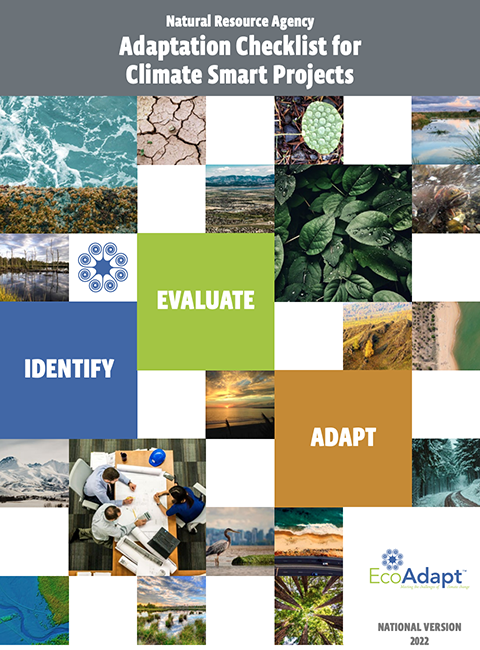
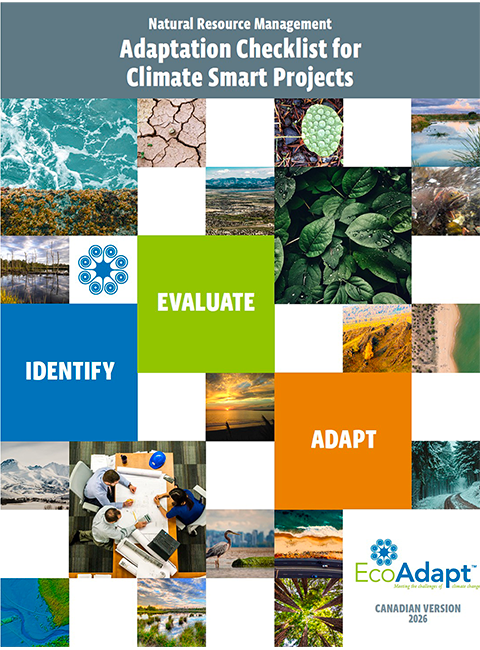
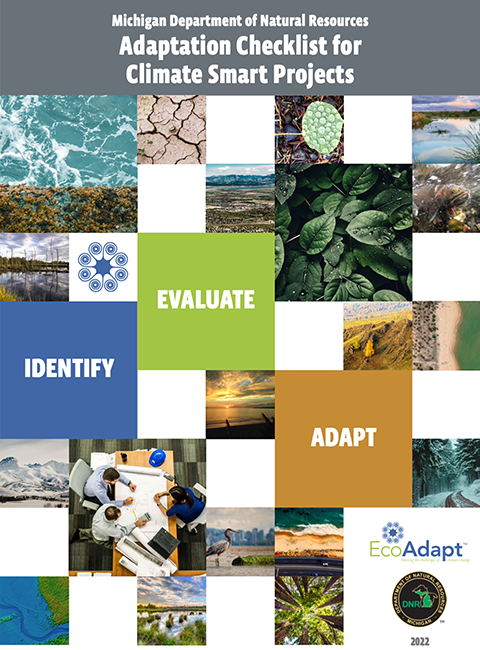
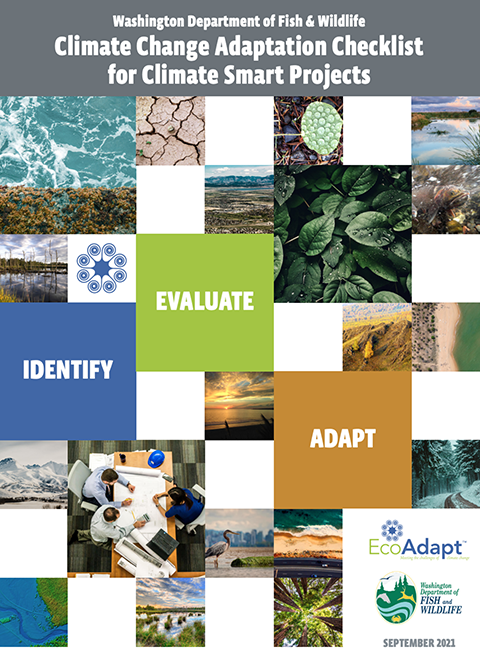
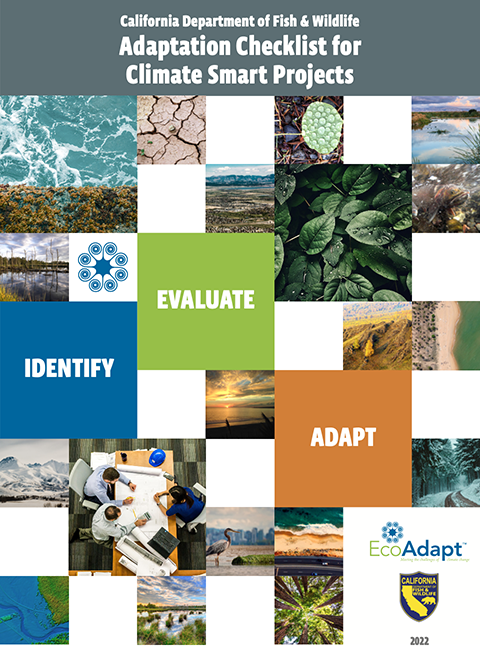
Adaptation Checklist for Climate Smart Projects
A Tool for Natural Resource Agencies
Climate change has implications for both the effectiveness and hazard risk potential of many projects and activities undertaken or reviewed by natural resource management agencies. Failing to evaluate the potential vulnerability of a project or action prior to implementation or approval can lead to missed opportunities to improve design, optimize siting or otherwise reduce risk. While this tool is most easily used in evaluating a place-based project, it can be used to assess the climate savviness of many types of actions as well as policies.
How Can I Use the Checklist?
This tool is designed to help you determine if, given climate change, your project will continue to deliver intended benefits.
The Checklist supports your ability to:
- Explicitly evaluate the implications of future conditions on project function, longevity and impact
- Build climate consideration directly into funding, permitting and planning phases
- Reduce liabilities or avoid actions that will be ineffective under future conditions
What Projects Can I Use the Checklist For?
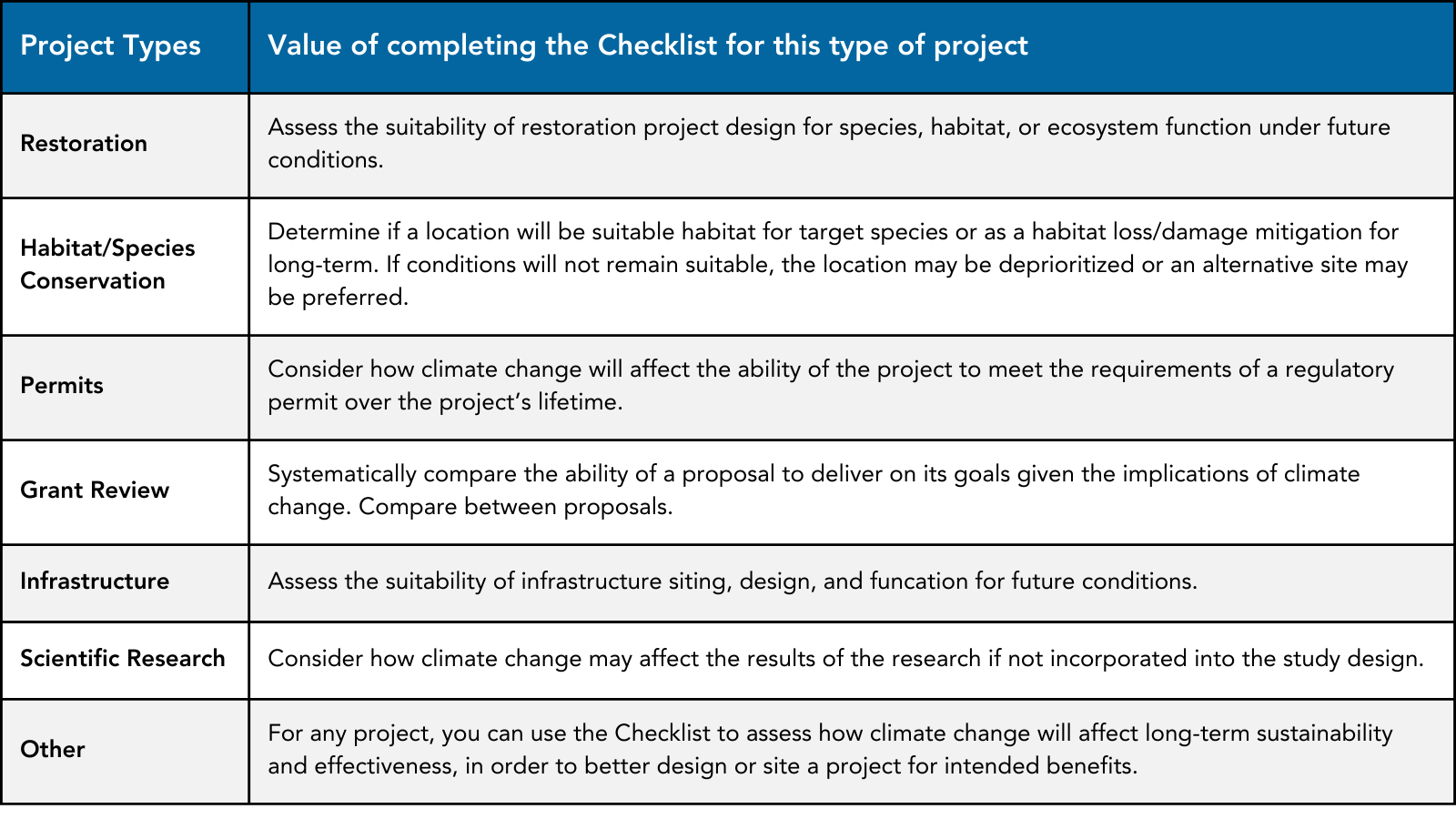
STEP 1: Identify
Climate Quick Check
For Step 1, you want to identify which aspects of climate change will be relevant to the project over its lifetime by considering a range of indicators.
It's important to consider the environment where your project will take place. Identify whether it will be near/in water or on land and whether it may be affected by factors such as sea level rise, erosion, drought, or changes in temperature and precipitation. It's also important to identify any other potential disturbances that could impact your project.
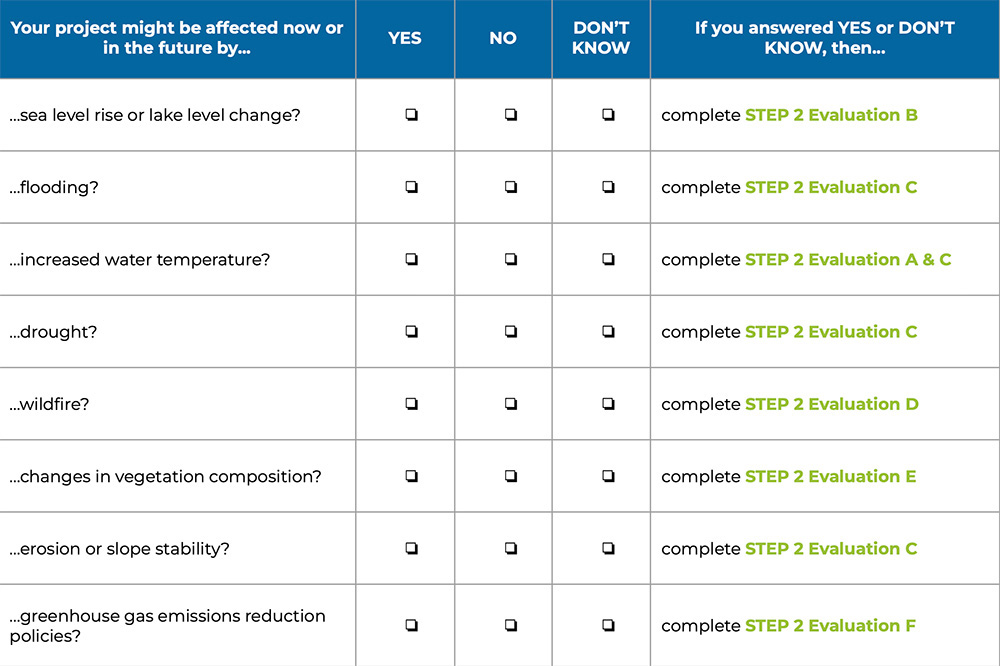
STEP 2: Evaluate
Evaluation of Climate Impact on a Project
In Step 2, you will explore how those relevant aspects of climate change may be affecting the project by answering specific questions and considering available data.
To do this, you will evaluate the following elements and determine their impact:
- The suitability of the project site, species, and/or infrastructure to future air and water temperature patterns
- Local sea level rise and/or lake level change projections relevant to the project area
- The project's suitability for future precipitation patterns
- The project's vulnerability to wildfire
- The project's vulnerability to changes in ecological function (e.g., shifts in phenology, range, composition, connectivity, fitness, predation)
- The project's contribution to greenhouse gas emissions and sequestration
Possible sources of local data include products from the Climate Adaptation Science Centers, the U.S. Climate Resilience Toolkit, regional universities, regional climate research groups, and state and federal agencies.
- NOAA Climate Explorer
- Future Climate Projections for Pacific Northwest and Great Basin Tribes
- NOAA Sea Level Rise Viewer
only shows <6 feet. If your scenario shows >6 feet, use Surging Sea - NOAA Coastal Flood Exposure Maps
- NOAA Sea Level Rise Technical Report
- IPCC Projections
- National Integrated Drought Information System
- FEMA Flood Maps
- Wildfire Risk Explorer
for communities but could inform regionally - USGS Landfire
- Seedlot Selection Tool
- Climate Forest Vegetation Simulator
- Invasive Range Expander Listing Tool
STEP 3: Adapt
Synopsis & Adaptation Options
In Step 3, you will take each identified vulnerability in Step 2 and develop adaptation options to avoid, minimize, or mitigate future negative impacts while delivering the intended benefits. You can use the adaptation support resources detailed in Step 3 of the checklist to find potential options.
Useful Resources
- Northern Institute of Applied Climate Science Adaptation Workbook
- California's Fourth Climate Change Assessment
- Resist-Accept-Direct (RAD) - A Framework for the 21st-Century Natural Resource Manager
- Dibaginjigaadeg Anishinaabe Ezhitwaad: A Tribal Climate Adaptation Menu
- Tribal Climate Adaptation Guidebook
- Adaptation Clearinghouse-California
- Adaptation Clearinghouse for policy examples
- U.S. Climate Resilience Toolkit
- Climate Impacts Research Consortium Climate Toolbox
- Resilient Lands Mapping Tool
- Climate Change Scenario Planning Showcase
United States
Canada
Michigan
Washington
California
Interested in a tool for community project planning? The Climate Change Adaptation Certification Tool: Moving communities from planning to implementation has two versions — Canadian and United States — and a companion tutorial
Adaptation Checklist for Climate Smart Projects ©2022 EcoAdapt
This project was supported by the Northwest Climate Adaptation Science Center (NW CASC)
and the Washington Department of Fish & Wildlife
and the Washington Department of Fish & Wildlife